Scenarios for Export-Led Green Growth in Estonia. Data-Driven Roadmaps for Catalyzing Green Growth in Eastern Europe
This research examines economic development opportunities arising for Estonia from Europe’s green industrial transition by analysing trade patterns, technological capabilities and import dependencies in low-carbon and environmental goods. Combining qualitative scenarios with quantitative export-potential analysis, the report explores how geopolitical fragmentation, technological competition, energy insecurity and the green transition may reshape Europe’s industrial development and Estonia’s export opportunities in the coming decades.
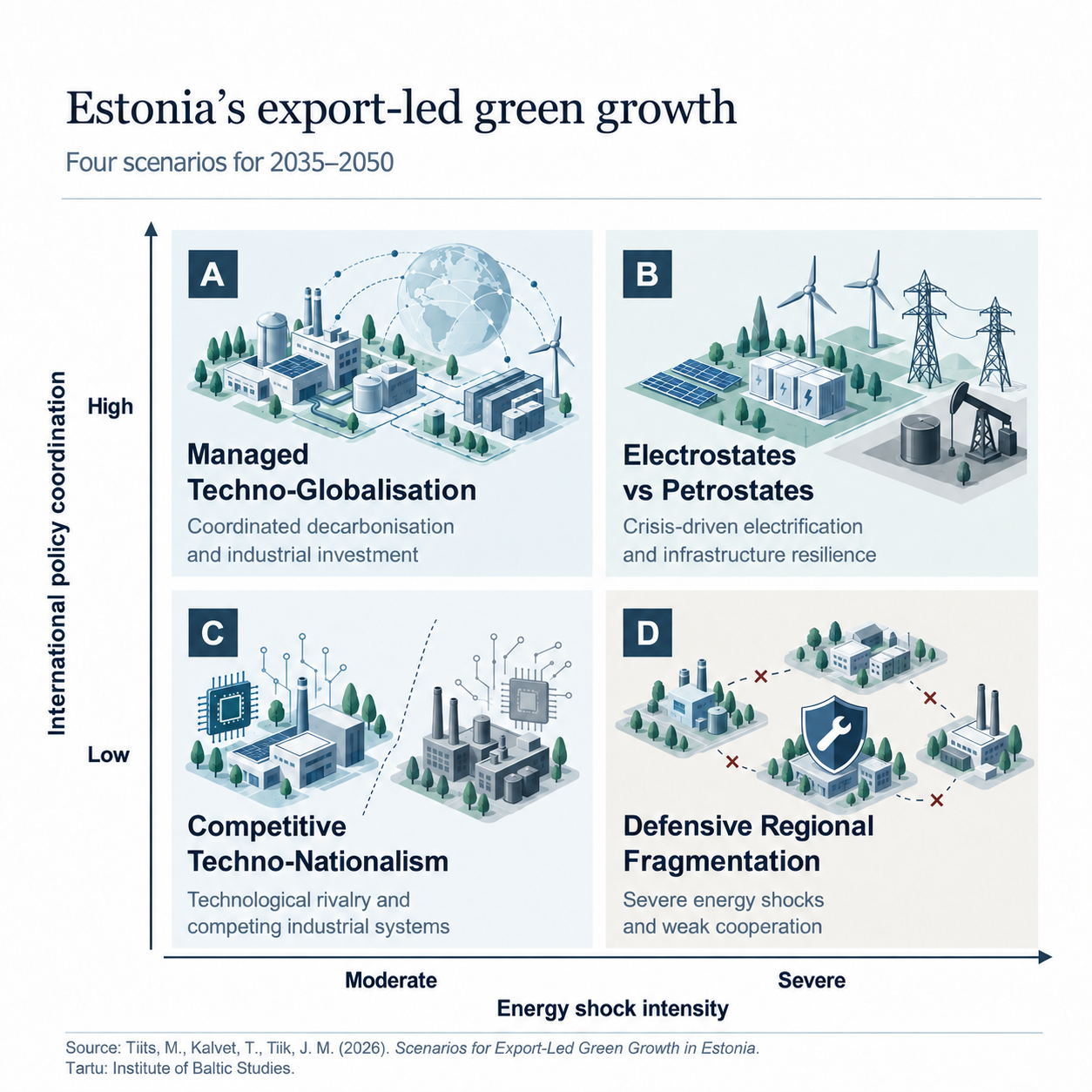
The scenario analysis examines how Estonia’s export-led green growth prospects may evolve under four alternative futures shaped by two critical uncertainties: the level of international policy coordination and the intensity of future energy-system shocks. Across all scenarios, Europe’s green transition continues, although its pace, geography and industrial logic differ substantially.
In the Managed Techno-Globalisation scenario, stronger international coordination and moderate energy shocks support stable investment conditions, strategic trade and rapid diffusion of low-carbon and digital technologies. Estonia benefits from broad export markets and opportunities in industrial automation, smart infrastructure, analytical systems and specialised engineering.
In the Electrostates vs Petrostates scenario, severe energy disruptions accelerate electrification and deepen cooperation among countries seeking to reduce dependence on fossil-fuel suppliers. Estonia’s opportunities become more concentrated within allied electrification systems, particularly in smart grids, control systems, monitoring technologies and infrastructure-resilience solutions.
In the Competitive Techno-Nationalism scenario, technological rivalry, export controls and industrial subsidies fragment global markets. Estonia’s competitiveness depends on becoming a trusted specialist supplier within selected European and allied industrial ecosystems, particularly in precision instrumentation, AI-enabled industrial control systems and cyber-secure infrastructure solutions.
In the Defensive Regional Fragmentation scenario, severe energy shocks combine with weak international coordination, increasing the importance of regional resilience. Estonia’s strongest role lies within Baltic–Nordic–Polish–German infrastructure systems, where reliability, servicing capacity and geographical proximity become key competitive advantages.
Across the scenarios, Estonia’s low-carbon technology opportunities vary more by market context and strategic logic than by core product groups. Estonia’s strongest opportunities lie in specialised engineering and infrastructure integration rather than scale-intensive manufacturing. The most promising areas are AI-enabled industrial control systems, smart electrical infrastructure, monitoring technologies and specialised machinery. More advanced activities in electronics, batteries and photonics depend more heavily on foreign investment and on integration into wider European industrial ecosystems. The main strategic risk for a small open economy is not betting on the wrong technologies. It is remaining optimised for a gradually disappearing world of stable geopolitics, frictionless trade and low-cost global supply chains.
The report translates these findings into a development roadmap for low-carbon technology exports. The IMF-defined set of low-carbon products is assessed at the detailed product level along four dimensions: existing export strength and revealed comparative advantage, relatedness to capabilities already present in the economy, product complexity and complexity outlook gain, and estimated export potential. The evidence distinguishes three action lines, which differ in their distance from Estonia’s current capability base and therefore in the measures and time horizons they require. The detailed product-level indicators and market opportunities are available through green.goodtrade.ai.
The first and most immediate action is to scale existing export strengths: electrical control boards and integrated control systems, precision measurement and regulation technologies, electric motor, generator and transformer components, and specialised machinery and process equipment. Here, the objective for 2026–2027 is export scaling rather than diversification, through market expansion, certification, procurement access and deeper value-chain integration.
The second is to develop adjacent capabilities, where Estonia lacks an export position but is close to establishing one: electrical switching systems, physical and chemical analysis instruments, gas filtration and purification technologies, and specialised electrical measurement components. The horizon here is 2028–2034, and the instruments are applied R&D, demonstration projects, supplier development, and standards and certification support.
The third is to build a limited number of strategic platforms with high complexity and market potential but a larger capability gap, such as lithium-ion accumulators, multilayer ceramic capacitors, lasers and advanced optical instruments. Entry depends on foreign investment, technology partnerships, research and testing infrastructure, and European value-chain integration; long-term capability building should start now, even if major export effects take several years to appear.
Three conditions cut across the scenarios. Competitiveness depends increasingly on implementation capability rather than on technology availability, with infrastructure deployment, engineering capacity, industrial digital skills and systems integration recurring as binding constraints, and a competitive and predictable electricity supply remaining a foundational condition under every scenario. Trusted-supplier status matters as much as the technology itself, resting on certification capability, cybersecurity competence and long-term servicing capacity.
Baltic–Nordic–Polish–German integration also becomes more important across all futures, since Estonia’s position within Northern European infrastructure systems favours participation in regional industrial ecosystems and strengthens its place in European value chains.
Upgrading is likely to proceed along two complementary routes: gradual expansion by domestic firms into adjacent engineering-intensive products, and foreign-investment-led entry into higher-complexity activities, where anchor investments may also build wider ecosystems of specialised suppliers, engineering firms and maintenance services.
We conclude that Estonia’s long-term competitiveness depends less on scale or cost competition and more on becoming technologically specialised, operationally reliable and hard to replace within European low-carbon industrial and infrastructure systems.