What is war and when does it start? A cursory introduction into thinking about war
Read moreWith security concerns once again at the centre of European political debates, global economic pressures rising, and the post-World War II world order more fragmented than ever, climate policy seems to have taken a backseat.
This is, of course, understandable to a degree. When people are worried about their energy bills and watching the war unfold in Ukraine and in the Middle East, climate change concerns can feel distant. However, climate change is not detached from Europe’s security issues. In reality, these issues are increasingly intertwined. And ignoring this could leave Europe more vulnerable in the future.
From Defence Challenges to Geopolitics
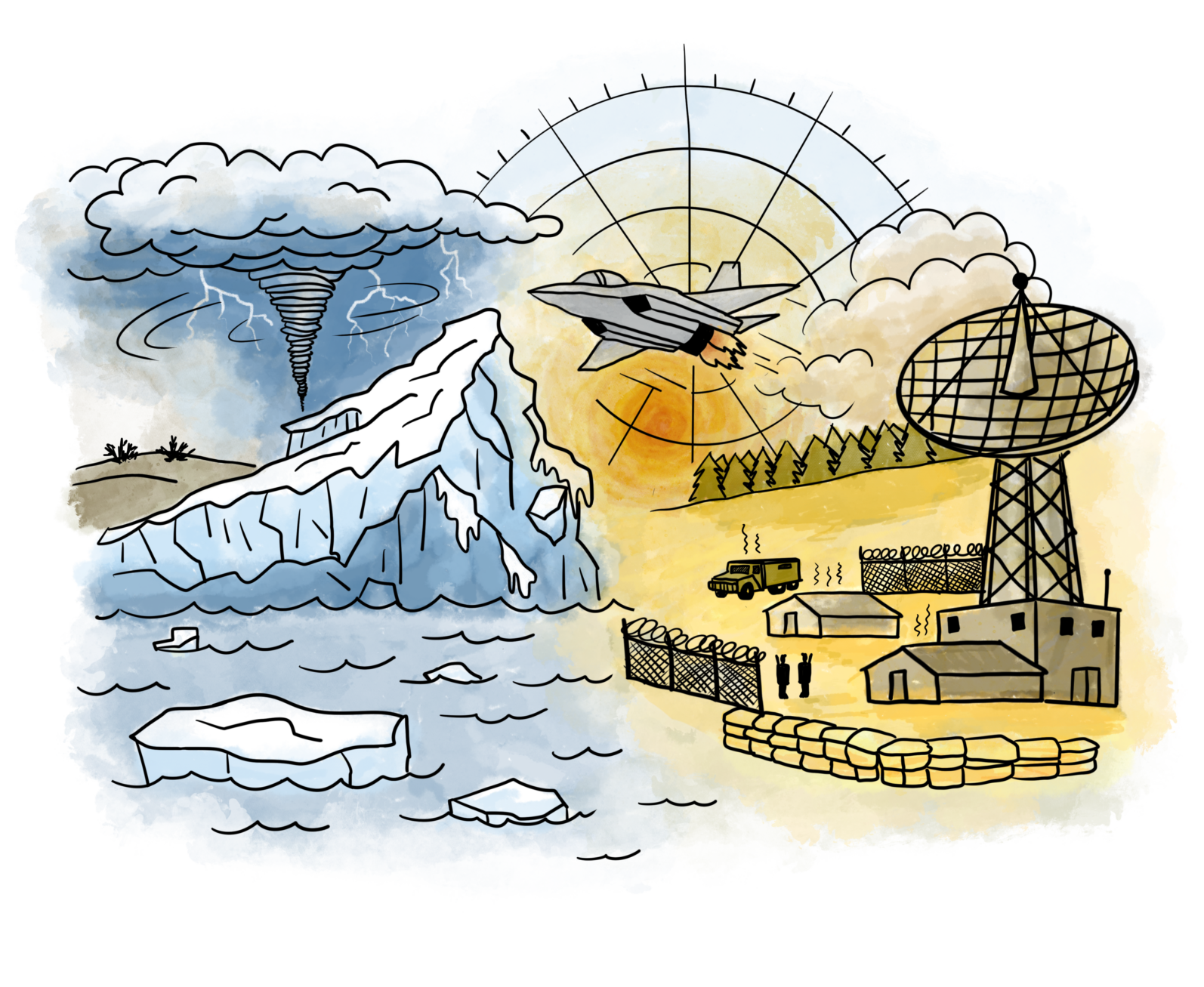
Climate change is already affecting the preparedness of European armed forces. In the summer of 2022, the UK’s Royal Air Force was forced to suspend flights from one of their bases, as a heatwave had melted the runways. France has warned that its military helicopters have issues taking off in over 45-degree temperatures, which is projected to be commonplace for several months of the year in the Middle East by mid-century. And at times, this temperature limit has already been exceeded in Afghanistan. But the problem is not limited to extreme heat. For instance, NATO assessments have pointed out that the on average warmer winters are undermining winter combat training of the Finnish defence forces. These examples highlight a simple reality: extreme weather and climate damage are no longer potential future scenarios but present-day concerns for militaries across the continent.
The effects of climate change on European security go beyond direct concerns about our defence capabilities. With the melting of the Arctic ice, new trade routes are opening, potentially cutting fuel costs and travel time between northern Europe and northeast Asia by 40%. Moreover, the Arctic is rich in natural resources, the extraction of which is becoming more viable. As a result, great powers, such as Russia, China, and the US, are increasingly interested in the region, leading to the Arctic becoming ever more militarised. For northern Europe, this results in a more unpredictable security environment, as the risk of tensions and conflict rises. Aside from geopolitics, climate change is also affecting local communities, with indigenous peoples among those most impacted. Traditional ways of hunting and fishing are becoming less reliable due to the changing environment, impacting food security, which may contribute to future unrest and social divisions.
Climate change thus acts as a ‘threat multiplier’—both in warmer and colder climates with varying quality of governance. In other words, it may not directly cause security risks, but it intensifies already existing tensions and instabilities by aggravating other issues. The effects of climate change are both exacerbating the underlying geopolitical tensions and negatively affecting the living standards of inhabitants. Or as academic Gabriella Gricius puts it: “Traditional and environmental security are no longer different types of security, but rather two sides of the same coin.”
One of the most contested issues at the climate–security nexus is climate-induced migration. This is often portrayed as a simple causal chain from environmental stress to displacement and instability. In practice, migration is rarely driven by climate factors alone: environmental shocks interact with poverty, economic insecurity (especially in agriculture-dependent regions), weak governance, and limited capacity to adapt. Again, climate change should be seen less as a direct cause of migration than as a threat multiplier, intensifying pre-existing vulnerabilities. There are, however, cases in which climate stress has been a critical tipping factor, rendering livelihoods or entire areas increasingly unviable, and in the future, these instances will become common. Even then, most climate-related mobility remains internal or regional rather than cross-continental, given that the majority of affected populations prefer to stay close to their home regions whenever possible.
Naturally, Russia’s war against Ukraine also has a clear climate and energy dimension. Russia’s economy is held up by its fossil fuel exports. In principle, European leaders acknowledge widely that if Europe and the world as a whole were to seriously divest from its reliance on (Russian) fossil fuels, Russia would be less able to threaten European security. In practice, however, this recognition has repeatedly clashed with short-term national energy and economic interests. Therefore, at the EU level, several member states have sought to delay, dilute, or at times even block comprehensive sanctions on Russian fossil fuels, reflecting their historic domestic energy mixes and concerns over economic disruption rather than strategic awareness.
The war in the Middle East similarly has major climate-related ramifications. Both sides of the conflict with Iran have specifically targeted energy infrastructure, such as oil refineries and liquefied natural gas (LNG) plants, a tactic that has also been employed in Ukraine. This has released significant amounts of pollutants into the atmosphere and is projected to cause long lasting environmental damage and health risks to the region’s population, further increasing instability in the long run. In addition, the conflict has exposed food and water security concerns. The import of food to the Gulf States and Iran has been disrupted and strikes on desalination plants threaten local food production. The region is also a major producer of synthetic fertilizers. The halting of fertilizer exports will have significant negative effects on global food security. The lack of available fertilizers is also affecting the agricultural sectors of countries like Estonia, which could lead to higher food prices and raising food security concerns in Europe.
However, much like the invasion of Ukraine exposed weaknesses about Europe’s reliance on fossil fuels, so has the conflict in the Middle East. The US and Israeli war with Iran and the subsequent closing of the Strait of Hormuz have led to major disruptions of oil exports, causing the price of oil to surge. Similarly, Qatar, one of the world’s largest LNG exporters, has stopped production due to the conflict. Therefore, the current crisis in the Middle East has again exposed the risks related to reliance on the global fossil fuel supply in a world increasingly characterised by geopolitical instability. Renewable energy sources, on the other hand, are arguably less vulnerable to conflict-related disruptions. Once constructed, wind, solar, and other renewable technologies do not rely on consistent import of fuel through easily damaged or externally controlled infrastructure. In parallel, building up European own clean tech manufacturing capacity is crucial.
Disruptions to the supply of material required for construction of renewable energy sources mostly affect future development, not the functioning of existing infrastructure. Whether or not this crisis leads to Europe seriously divesting from fossil fuels remains to be seen.
What is Being Done
In summary, these developments show that climate policy and security policy are far more closely linked than it would first seem. NATO has long acknowledged the challenges brought by environmental concerns, highlighting that the effects of climate change exacerbate conflict and tensions. This is essentially NATO-speak for a simple idea: climate change makes already fragile situations worse. The same is recognised by the EU’s strategic documents.
The connection between climate change and security issues is also appearing in the policies of individual European countries. Recent research on the UK’s armed forces’ so-called transition to low-carbon warfare shows that several climate initiatives and commitments have emerged recently, suggesting that environmental and energy issues are becoming an important factor in defence planning. These initiatives range from reducing emissions of military bases to research into more energy-efficient equipment and alternative fuels. A separate study of EU member states militaries similarly finds that climate issues are mentioned more often in new security and defence strategies. Yet both studies point out that progress is slow and much of it remains talk rather than action. Militaries are not easy to transform. However, it is not impossible. A study analysing the greenhouse gas emissions of the Norwegian armed forces shows that direct military activity only amounts to a 32% of all emissions. The remaining 68% is made up of indirect emissions from procurement. This suggests that green procurement practices could be an effective strategy for mitigating the environmental footprint of the defence sector without sacrificing operational capabilities.
Looking Forward
Moving towards the green transition is not easy, and the challenges are especially visible in a sensitive sector like security and defence. Yet a more environmentally conscious approach also offers clear strategic benefits. Europe’s continued reliance on fossil fuels from increasingly unpredictable, if not outright hostile, states remains a major weakness. The energy crisis emerging after Russia’s invasion of Ukraine highlighted just how closely security and energy systems are intertwined, a point reinforced by the Institute of Baltic Studies’ Global Megatrends study, which identifies energy dependence and fragile supply chains as major weaknesses in an era of geopolitical rivalry.
Investing in renewables, alternative fuels, and energy efficiency could, therefore, help both achieve the EU’s climate goals and strengthen its autonomy. At the same time, developing new more climate-fit solutions in military technology could give European armies a long-term advantage. This could allow them to shape a whole new approach to military technology and strategy. These investments would also spill over into the wider economy, advancing clean-tech innovation, revitalising parts of the defence industry, and creating new jobs.
Perhaps even more crucially, building up adaptation capabilities and resilience to an increasingly warmer planet is needed. As it stands, both existing infrastructure and armed forces remain poorly prepared for the operational threats posed by climate volatility.
Illustration: Merike Paberits